•  
Offshore Yellowfin Tuna Breeding Base - China

Offshore Yellowfin Tuna Breeding Base - China

Qin Chuanxin, a researcher at the South China Sea Fisheries Research Institute of the Chinese Academy of Fishery Sciences, shows a specimen of yellowfin tuna in Lingshui Li Autonomous County, south China's Hainan Province, on Sept. 17, 2025. In recent years, Hainan Province has accelerated the development of its fishery industry by giving full play to its advantages in marine fisheries. Thanks to technological breakthroughs, the South China Sea Fisheries Research Institute of the Chinese Academy of Fishery Sciences established an offshore yellowfin tuna breeding base in Lingshui, which has achieved artificial spawning and hatching of yellowfin tunas. Photo by Xinhua/Guo Cheng/ABACAPRESS.COM

  •  
Offshore Yellowfin Tuna Breeding Base - China

Offshore Yellowfin Tuna Breeding Base - China

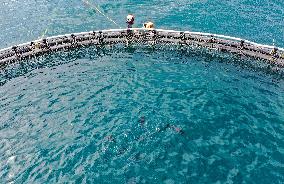
An aerial drone photo taken on Sept. 17, 2025 shows staff members feeding tunas at an offshore yellowfin tuna breeding base in Lingshui Li Autonomous County, south China's Hainan Province. In recent years, Hainan Province has accelerated the development of its fishery industry by giving full play to its advantages in marine fisheries. Thanks to technological breakthroughs, the South China Sea Fisheries Research Institute of the Chinese Academy of Fishery Sciences established an offshore yellowfin tuna breeding base in Lingshui, which has achieved artificial spawning and hatching of yellowfin tunas. Photo by Xinhua/Guo Cheng/ABACAPRESS.COM

  •  
Offshore Yellowfin Tuna Breeding Base - China

Offshore Yellowfin Tuna Breeding Base - China

An aerial drone photo taken on Sept. 17, 2025 shows staff members feeding tunas at an offshore yellowfin tuna breeding base in Lingshui Li Autonomous County, south China's Hainan Province. In recent years, Hainan Province has accelerated the development of its fishery industry by giving full play to its advantages in marine fisheries. Thanks to technological breakthroughs, the South China Sea Fisheries Research Institute of the Chinese Academy of Fishery Sciences established an offshore yellowfin tuna breeding base in Lingshui, which has achieved artificial spawning and hatching of yellowfin tunas. Photo by Xinhua/Guo Cheng/ABACAPRESS.COM

  •  
Offshore Yellowfin Tuna Breeding Base - China

Offshore Yellowfin Tuna Breeding Base - China

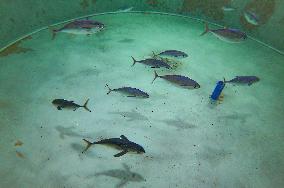
This photo taken on Sept. 17, 2025 shows yellowfin tunas undergoing an experiment at the South China Sea Fisheries Research Institute of the Chinese Academy of Fishery Sciences in Lingshui Li Autonomous County, south China's Hainan Province. In recent years, Hainan Province has accelerated the development of its fishery industry by giving full play to its advantages in marine fisheries. Thanks to technological breakthroughs, the South China Sea Fisheries Research Institute of the Chinese Academy of Fishery Sciences established an offshore yellowfin tuna breeding base in Lingshui, which has achieved artificial spawning and hatching of yellowfin tunas. Photo by Xinhua/Guo Cheng/ABACAPRESS.COM

  •  
Offshore Yellowfin Tuna Breeding Base - China

Offshore Yellowfin Tuna Breeding Base - China

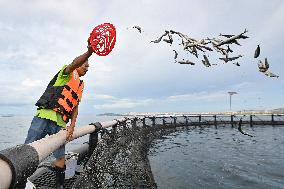
A staff member feeds tunas at an offshore yellowfin tuna breeding base in Lingshui Li Autonomous County, south China's Hainan Province, on Sept. 17, 2025. In recent years, Hainan Province has accelerated the development of its fishery industry by giving full play to its advantages in marine fisheries. Thanks to technological breakthroughs, the South China Sea Fisheries Research Institute of the Chinese Academy of Fishery Sciences established an offshore yellowfin tuna breeding base in Lingshui, which has achieved artificial spawning and hatching of yellowfin tunas. Photo by Xinhua/Guo Cheng/ABACAPRESS.COM

  •  
Offshore Yellowfin Tuna Breeding Base - China

Offshore Yellowfin Tuna Breeding Base - China

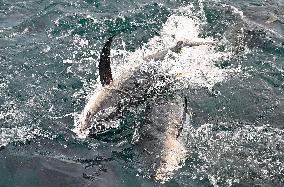
This photo taken on Sept. 17, 2025 shows tunas vying for food at an offshore yellowfin tuna breeding base in Lingshui Li Autonomous County, south China's Hainan Province. In recent years, Hainan Province has accelerated the development of its fishery industry by giving full play to its advantages in marine fisheries. Thanks to technological breakthroughs, the South China Sea Fisheries Research Institute of the Chinese Academy of Fishery Sciences established an offshore yellowfin tuna breeding base in Lingshui, which has achieved artificial spawning and hatching of yellowfin tunas. Photo by Xinhua/Guo Cheng/ABACAPRESS.COM

  •  
Launches Unmanned Swarm for Scientific Research in Xiangyanghong 10 - China

Launches Unmanned Swarm for Scientific Research in Xiangyanghong 10 - China

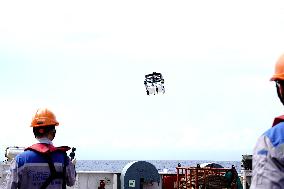
A cross-domain robot takes off from the "Xiangyanghong 10" to conduct scientific research in the northern waters of the South China Sea, July 8, 2025. Chinese researchers successfully carried out scientific tests involving various types of drones, unmanned surface vessels, and autonomous underwater vehicles aboard the "Xiangyanghong 10" in the northern waters of the South China Sea in recent days. The "Innovative Integrated Intelligent Systems Expedition," led by the Advanced Institute for Ocean Research under Southern University of Science and Technology, in collaboration with multiple research institutes, high-tech companies, and science popularization organizations, conducted real-time assessments of the innovation, integration, and intelligence of these unmanned scientific exploration devices. Photo by Zhang Jiansong/Xinhua/ABACAPRESS.COM

  •  
Launches Unmanned Swarm for Scientific Research in Xiangyanghong 10 - China

Launches Unmanned Swarm for Scientific Research in Xiangyanghong 10 - China

Chief scientist of the "Innovative Integrated Intelligent Systems Expedition" Lin Jian (C), also dean and chair professor of the Advanced Institute for Ocean Research at Southern University of Science and Technology, supervises operations of scientific research aboard the "Xiangyanghong 10" in the northern waters of the South China Sea, July 8, 2025. Chinese researchers successfully carried out scientific tests involving various types of drones, unmanned surface vessels, and autonomous underwater vehicles aboard the "Xiangyanghong 10" in the northern waters of the South China Sea in recent days. The "Innovative Integrated Intelligent Systems Expedition," led by the Advanced Institute for Ocean Research under Southern University of Science and Technology, in collaboration with multiple research institutes, high-tech companies, and science popularization organizations, conducted real-time assessments of the innovation, integration, and intelligence of these unmanned scientific exploration devices. Photo by Zhan

  •  
Launches Unmanned Swarm for Scientific Research in Xiangyanghong 10 - China

Launches Unmanned Swarm for Scientific Research in Xiangyanghong 10 - China

The "Xiangyanghong 10" conducts "Unmanned Swarm" scientific research in the northern waters of the South China Sea, July 8, 2025. Chinese researchers successfully carried out scientific tests involving various types of drones, unmanned surface vessels, and autonomous underwater vehicles aboard the "Xiangyanghong 10" in the northern waters of the South China Sea in recent days. The "Innovative Integrated Intelligent Systems Expedition," led by the Advanced Institute for Ocean Research under Southern University of Science and Technology, in collaboration with multiple research institutes, high-tech companies, and science popularization organizations, conducted real-time assessments of the innovation, integration, and intelligence of these unmanned scientific exploration devices. Photo by Zhang Jiansong/Xinhua/ABACAPRESS.COM

  •  
Launches Unmanned Swarm for Scientific Research in Xiangyanghong 10 - China

Launches Unmanned Swarm for Scientific Research in Xiangyanghong 10 - China

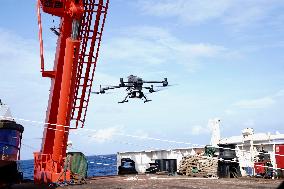
A thermal-imaging surveillance unmanned aerial vehicle (UAV) takes off from the "Xiangyanghong 10" to conduct scientific research in the northern waters of the South China Sea, July 8, 2025. Chinese researchers successfully carried out scientific tests involving various types of drones, unmanned surface vessels, and autonomous underwater vehicles aboard the "Xiangyanghong 10" in the northern waters of the South China Sea in recent days. The "Innovative Integrated Intelligent Systems Expedition," led by the Advanced Institute for Ocean Research under Southern University of Science and Technology, in collaboration with multiple research institutes, high-tech companies, and science popularization organizations, conducted real-time assessments of the innovation, integration, and intelligence of these unmanned scientific exploration devices. Photo by Zhang Jiansong/Xinhua/ABACAPRESS.COM

  •  
Launches Unmanned Swarm for Scientific Research in Xiangyanghong 10 - China

Launches Unmanned Swarm for Scientific Research in Xiangyanghong 10 - China

The "Dolphin 3" surface rescue robot conducts test in the northern waters of the South China Sea, July 9, 2025. Chinese researchers successfully carried out scientific tests involving various types of drones, unmanned surface vessels, and autonomous underwater vehicles aboard the "Xiangyanghong 10" in the northern waters of the South China Sea in recent days. The "Innovative Integrated Intelligent Systems Expedition," led by the Advanced Institute for Ocean Research under Southern University of Science and Technology, in collaboration with multiple research institutes, high-tech companies, and science popularization organizations, conducted real-time assessments of the innovation, integration, and intelligence of these unmanned scientific exploration devices. Photo by Zhang Jiansong/Xinhua/ABACAPRESS.COM

  •  
Launches Unmanned Swarm for Scientific Research in Xiangyanghong 10 - China

Launches Unmanned Swarm for Scientific Research in Xiangyanghong 10 - China

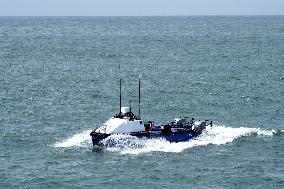
An unmanned survey vessel conducts scientific research in the northern waters of the South China Sea, July 9, 2025. Chinese researchers successfully carried out scientific tests involving various types of drones, unmanned surface vessels, and autonomous underwater vehicles aboard the "Xiangyanghong 10" in the northern waters of the South China Sea in recent days. The "Innovative Integrated Intelligent Systems Expedition," led by the Advanced Institute for Ocean Research under Southern University of Science and Technology, in collaboration with multiple research institutes, high-tech companies, and science popularization organizations, conducted real-time assessments of the innovation, integration, and intelligence of these unmanned scientific exploration devices. Photo by Zhang Jiansong/Xinhua/ABACAPRESS.COM

  •  
Launches Unmanned Swarm for Scientific Research in Xiangyanghong 10 - China

Launches Unmanned Swarm for Scientific Research in Xiangyanghong 10 - China

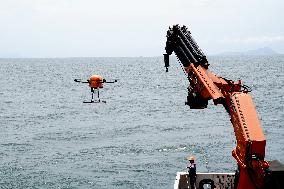
An aeromagnetic fixed-wing unmanned aerial vehicle (UAV) flies over the "Xiangyanghong 10" to conduct scientific research in the northern waters of the South China Sea, July 9, 2025. Chinese researchers successfully carried out scientific tests involving various types of drones, unmanned surface vessels, and autonomous underwater vehicles aboard the "Xiangyanghong 10" in the northern waters of the South China Sea in recent days. The "Innovative Integrated Intelligent Systems Expedition," led by the Advanced Institute for Ocean Research under Southern University of Science and Technology, in collaboration with multiple research institutes, high-tech companies, and science popularization organizations, conducted real-time assessments of the innovation, integration, and intelligence of these unmanned scientific exploration devices. Photo by Zhang Jiansong/Xinhua/ABACAPRESS.COM

  •  
Launches Unmanned Swarm for Scientific Research in Xiangyanghong 10 - China

Launches Unmanned Swarm for Scientific Research in Xiangyanghong 10 - China

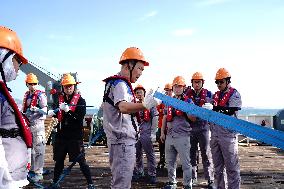
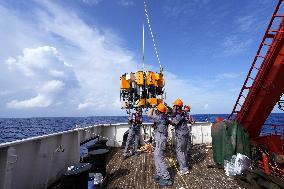
Researchers hoist an autonomous underwater vehicle into the sea in the northern waters of the South China Sea, July 8, 2025. Chinese researchers successfully carried out scientific tests involving various types of drones, unmanned surface vessels, and autonomous underwater vehicles aboard the "Xiangyanghong 10" in the northern waters of the South China Sea in recent days. The "Innovative Integrated Intelligent Systems Expedition," led by the Advanced Institute for Ocean Research under Southern University of Science and Technology, in collaboration with multiple research institutes, high-tech companies, and science popularization organizations, conducted real-time assessments of the innovation, integration, and intelligence of these unmanned scientific exploration devices. Photo by Zhang Jiansong/Xinhua/ABACAPRESS.COM

  •  
Launches Unmanned Swarm for Scientific Research in Xiangyanghong 10 - China

Launches Unmanned Swarm for Scientific Research in Xiangyanghong 10 - China

An intelligent seawater sampling unmanned aerial vehicle (UAV) departs from the "Xiangyanghong 10" in the northern waters of the South China Sea, July 9, 2025. Chinese researchers successfully carried out scientific tests involving various types of drones, unmanned surface vessels, and autonomous underwater vehicles aboard the "Xiangyanghong 10" in the northern waters of the South China Sea in recent days. The "Innovative Integrated Intelligent Systems Expedition," led by the Advanced Institute for Ocean Research under Southern University of Science and Technology, in collaboration with multiple research institutes, high-tech companies, and science popularization organizations, conducted real-time assessments of the innovation, integration, and intelligence of these unmanned scientific exploration devices. Photo by Zhang Jiansong/Xinhua/ABACAPRESS.COM

  •  
Tea Picking Robot

Tea Picking Robot

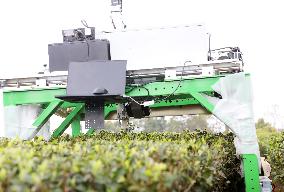
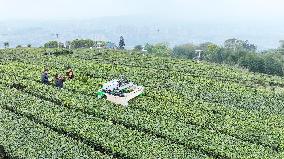
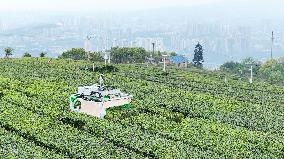
A tea picking robot picks buds in a tea plantation at the research base of the Tea Research Institute of the Chinese Academy of Agricultural Sciences in Chongqing, China on March 31, 2025.

  •  
Tea Picking Robot

Tea Picking Robot

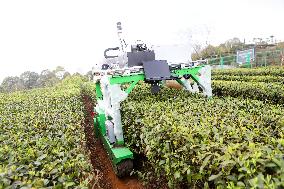
A tea picking robot picks buds in a tea plantation at the research base of the Tea Research Institute of the Chinese Academy of Agricultural Sciences in Chongqing, China on March 31, 2025.

  •  
Tea Picking Robot

Tea Picking Robot

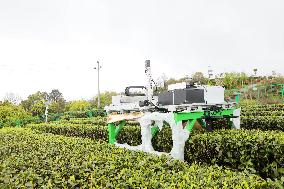
A tea picking robot picks buds in a tea plantation at the research base of the Tea Research Institute of the Chinese Academy of Agricultural Sciences in Chongqing, China on March 31, 2025.

  •  
Tea Picking Robot

Tea Picking Robot

A tea picking robot picks buds in a tea plantation at the research base of the Tea Research Institute of the Chinese Academy of Agricultural Sciences in Chongqing, China on March 31, 2025.

  •  
Tea Picking Robot

Tea Picking Robot

A tea picking robot picks buds in a tea plantation at the research base of the Tea Research Institute of the Chinese Academy of Agricultural Sciences in Chongqing, China on March 31, 2025.

  •  
Tea Picking Robot

Tea Picking Robot

A tea picking robot picks buds in a tea plantation at the research base of the Tea Research Institute of the Chinese Academy of Agricultural Sciences in Chongqing, China on March 31, 2025.

  •  
Tea Picking Robot

Tea Picking Robot

A tea picking robot picks buds in a tea plantation at the research base of the Tea Research Institute of the Chinese Academy of Agricultural Sciences in Chongqing, China on March 31, 2025.

  •  
Tea Picking Robot

Tea Picking Robot

A tea picking robot picks buds in a tea plantation at the research base of the Tea Research Institute of the Chinese Academy of Agricultural Sciences in Chongqing, China on March 31, 2025.

  •  
Tea Picking Robot

Tea Picking Robot

A tea picking robot picks buds in a tea plantation at the research base of the Tea Research Institute of the Chinese Academy of Agricultural Sciences in Chongqing, China on March 31, 2025.

  •  

IAEA takes seawater samples off Fukushima with China, others

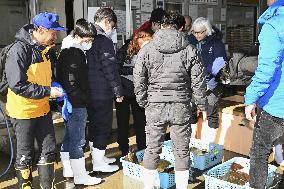
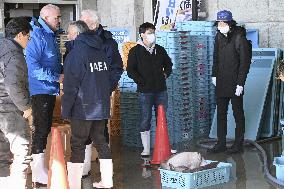
IWAKI, Japan, Feb. 20 Kyodo - An official from a Chinese research institute visits a fishing port in Iwaki in Fukushima Prefecture, northeastern Japan, to collect marine products to help monitor the seawater off the crippled Fukushima Daiichi nuclear power plant under the framework of the International Atomic Energy Agency. China is participating for the first time in the sample collection in Japan under the IAEA framework, which also includes institutes from South Korea, Switzerland and France. (Kyodo)

  •  
IAEA takes seawater samples off Fukushima with China, others

IAEA takes seawater samples off Fukushima with China, others

An official from a Chinese research institute (2nd from L) visits a fishing port in Iwaki in Fukushima Prefecture, northeastern Japan, to collect marine products to help monitor the seawater off the crippled Fukushima Daiichi nuclear power plant under the framework of the International Atomic Energy Agency. China is participating for the first time in the sample collection in Japan under the IAEA framework, which also includes institutes from South Korea, Switzerland and France.

  •  
IAEA takes seawater samples off Fukushima with China, others

IAEA takes seawater samples off Fukushima with China, others

An official from a Chinese research institute (2nd from R) visits a fishing port in Iwaki in Fukushima Prefecture, northeastern Japan, to collect marine products to help monitor the seawater off the crippled Fukushima Daiichi nuclear power plant under the framework of the International Atomic Energy Agency. China is participating for the first time in the sample collection in Japan under the IAEA framework, which also includes institutes from South Korea, Switzerland and France.

  •  
The Helicopter Airborne Magnetotelluric Detection System - China

The Helicopter Airborne Magnetotelluric Detection System - China

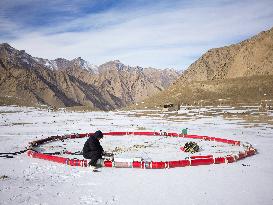
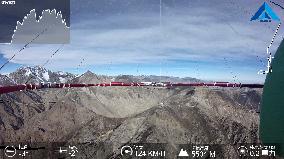
A researcher tests the helicopter airborne magnetotelluric detection system in Hetian, northwest China's Xinjiang Uygur Autonomous Region, January 11, 2025. China's first helicopter airborne magnetotelluric detection system has been successfully applied to a plateau railway construction project, the Chinese Academy of Sciences' Aerospace Information Research Institute (AIR) said on Tuesday. Photo by Guo Feng/Xinhua/ ABACAPRESS.COM

  •  
The Helicopter Airborne Magnetotelluric Detection System - China

The Helicopter Airborne Magnetotelluric Detection System - China

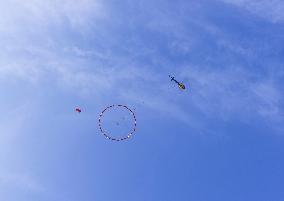
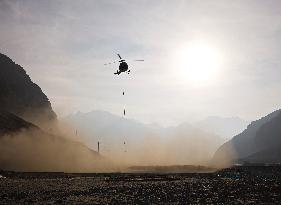
The helicopter airborne magnetotelluric detection system works in Hetian, northwest China's Xinjiang Uygur Autonomous Region, January 10, 2025. China's first helicopter airborne magnetotelluric detection system has been successfully applied to a plateau railway construction project, the Chinese Academy of Sciences' Aerospace Information Research Institute (AIR) said on Tuesday. Photo by Guo Feng/Xinhua/ ABACAPRESS.COM

  •  
The Helicopter Airborne Magnetotelluric Detection System - China

The Helicopter Airborne Magnetotelluric Detection System - China

The helicopter airborne magnetotelluric detection system works in Hetian, northwest China's Xinjiang Uygur Autonomous Region, December 21, 2024. China's first helicopter airborne magnetotelluric detection system has been successfully applied to a plateau railway construction project, the Chinese Academy of Sciences' Aerospace Information Research Institute (AIR) said on Tuesday. Photo by Guo Feng/Xinhua/ ABACAPRESS.COM

  •  
The Helicopter Airborne Magnetotelluric Detection System - China

The Helicopter Airborne Magnetotelluric Detection System - China

The helicopter airborne magnetotelluric detection system works in Hetian, northwest China's Xinjiang Uygur Autonomous Region, December 31, 2024. China's first helicopter airborne magnetotelluric detection system has been successfully applied to a plateau railway construction project, the Chinese Academy of Sciences' Aerospace Information Research Institute (AIR) said on Tuesday. Photo by Guo Feng/Xinhua/ ABACAPRESS.COM

  •  
The Helicopter Airborne Magnetotelluric Detection System - China

The Helicopter Airborne Magnetotelluric Detection System - China

This image shows the helicopter airborne magnetotelluric detection system working in Hetian, northwest China's Xinjiang Uygur Autonomous Region, December 28, 2024. China's first helicopter airborne magnetotelluric detection system has been successfully applied to a plateau railway construction project, the Chinese Academy of Sciences' Aerospace Information Research Institute (AIR) said on Tuesday. Photo by Huang Ling/Xinhua/ ABACAPRESS.COM

  •  
The Oldest Short-Tailed Bird Fossil Discovered - China

The Oldest Short-Tailed Bird Fossil Discovered - China

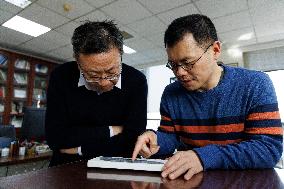
Wang Min (R), a researcher with the Institute of Vertebrate Paleontology and Paleoanthropology (IVPP) under the Chinese Academy of Sciences (CAS), and Zhou Zhonghe, an academician of CAS, discuss on possible directions in future research efforts on the fossilized bird Baminornis zhenghensis at an office of IVPP in Beijing, capital of China, on February 10, 2025. Chinese scientists have unearthed the oldest short-tailed bird fossil, dating back about 150 million years, in east China's Fujian Province. This suggests that birds might have originated earlier than previously thought. The fossilized bird Baminornis zhenghensis was discovered in Zhenghe County, Fujian Province. Its short tail ends in a compound bone called the pygostyle, a feature uniquely present in modern birds. This indicates that the body structure of modern birds emerged in the Late Jurassic Period, 20 million years earlier than previously known. The study, conducted by researchers from the Institute of Vertebrate Paleontology and Paleoanthropo

  •  
The Oldest Short-Tailed Bird Fossil Discovered - China

The Oldest Short-Tailed Bird Fossil Discovered - China

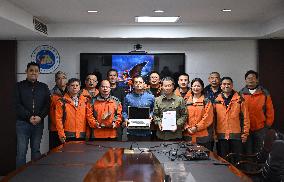
Some members of the research team of fossilized bird Baminornis zhenghensis pose for a group photo at the Fujian Institute of Geological Survey (FIGS) in Fuzhou, southeast China's Fujian Province, on February 11, 2025. Chinese scientists have unearthed the oldest short-tailed bird fossil, dating back about 150 million years, in east China's Fujian Province. This suggests that birds might have originated earlier than previously thought. The fossilized bird Baminornis zhenghensis was discovered in Zhenghe County, Fujian Province. Its short tail ends in a compound bone called the pygostyle, a feature uniquely present in modern birds. This indicates that the body structure of modern birds emerged in the Late Jurassic Period, 20 million years earlier than previously known. The study, conducted by researchers from the Institute of Vertebrate Paleontology and Paleoanthropology (IVPP) and the FIGS, was published in the latest issue of the journal Nature, on February 11, 2025,in Beijing, China. Photo by Jiang Kehong/X

  •  
Low-Energy High-Intensity Heavy-Ion Accelerator Facility - China

Low-Energy High-Intensity Heavy-Ion Accelerator Facility - China

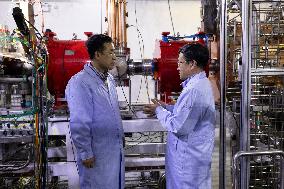
Sun Liangting, a researcher with the Institute of Modern Physics of the Chinese Academy of Sciences, checks equipment on December 10, 2024. The world's first stand-alone low-energy high-intensity heavy-ion accelerator facility (LEAF), developed by the Institute of Modern Physics of the Chinese Academy of Sciences, recently passed the expert panel acceptance inspection organized by the National Natural Science Foundation of China. The LEAF can provide intense heavy-ion beams and mixed ion beams of various charge states from light to heavy elements, offering advantages such as high beam intensity, high charge state, diverse ion species, and a wide range of energy variations. With the upgrading of ion accelerators and the evolution of accelerator technologies, frontier research in ion beam physics has continuously deepened human understanding of the world, and related application technologies have been widely adopted in various fields. Photo by Jin Liwang/Xinhua/ABACAPRESS.COM

  •  
Low-Energy High-Intensity Heavy-Ion Accelerator Facility - China

Low-Energy High-Intensity Heavy-Ion Accelerator Facility - China

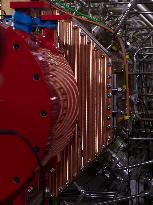
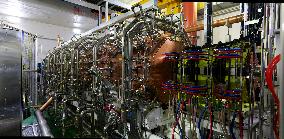
This photo taken on December 10, 2024 shows part of the low-energy high-intensity heavy-ion accelerator facility (LEAF). The world's first stand-alone low-energy high-intensity heavy-ion accelerator facility (LEAF), developed by the Institute of Modern Physics of the Chinese Academy of Sciences, recently passed the expert panel acceptance inspection organized by the National Natural Science Foundation of China. The LEAF can provide intense heavy-ion beams and mixed ion beams of various charge states from light to heavy elements, offering advantages such as high beam intensity, high charge state, diverse ion species, and a wide range of energy variations. With the upgrading of ion accelerators and the evolution of accelerator technologies, frontier research in ion beam physics has continuously deepened human understanding of the world, and related application technologies have been widely adopted in various fields. Photo by Jin Liwang/Xinhua/ABACAPRESS.COM

  •  
Low-Energy High-Intensity Heavy-Ion Accelerator Facility - China

Low-Energy High-Intensity Heavy-Ion Accelerator Facility - China

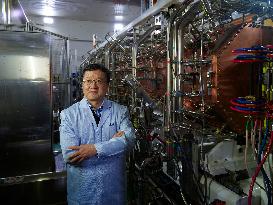
Zhao Hongwei, an academician of the Chinese Academy of Sciences (CAS), poses for a photo in front of the low-energy high-intensity heavy-ion accelerator facility (LEAF) on December 10, 2024. The world's first stand-alone low-energy high-intensity heavy-ion accelerator facility (LEAF), developed by the Institute of Modern Physics of the Chinese Academy of Sciences, recently passed the expert panel acceptance inspection organized by the National Natural Science Foundation of China. The LEAF can provide intense heavy-ion beams and mixed ion beams of various charge states from light to heavy elements, offering advantages such as high beam intensity, high charge state, diverse ion species, and a wide range of energy variations. With the upgrading of ion accelerators and the evolution of accelerator technologies, frontier research in ion beam physics has continuously deepened human understanding of the world, and related application technologies have been widely adopted in various fields. Photo by Jin Liwang/Xinhua

  •  
Low-Energy High-Intensity Heavy-Ion Accelerator Facility - China

Low-Energy High-Intensity Heavy-Ion Accelerator Facility - China

Zhao Hongwei (R), an academician of the Chinese Academy of Sciences (CAS), and Sun Liangting, a researcher with the Institute of Modern Physics of the CAS, discuss on experiment progress in front of the low-energy high-intensity heavy-ion accelerator facility (LEAF) on December 10, 2024. The world's first stand-alone low-energy high-intensity heavy-ion accelerator facility (LEAF), developed by the Institute of Modern Physics of the Chinese Academy of Sciences, recently passed the expert panel acceptance inspection organized by the National Natural Science Foundation of China. The LEAF can provide intense heavy-ion beams and mixed ion beams of various charge states from light to heavy elements, offering advantages such as high beam intensity, high charge state, diverse ion species, and a wide range of energy variations. With the upgrading of ion accelerators and the evolution of accelerator technologies, frontier research in ion beam physics has continuously deepened human understanding of the world, and relat

  •  
Low-Energy High-Intensity Heavy-Ion Accelerator Facility - China

Low-Energy High-Intensity Heavy-Ion Accelerator Facility - China

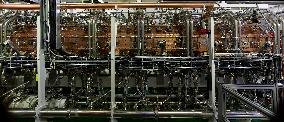
This stitched photo taken on December 10, 2024 shows part of the low-energy high-intensity heavy-ion accelerator facility (LEAF). The world's first stand-alone low-energy high-intensity heavy-ion accelerator facility (LEAF), developed by the Institute of Modern Physics of the Chinese Academy of Sciences, recently passed the expert panel acceptance inspection organized by the National Natural Science Foundation of China. The LEAF can provide intense heavy-ion beams and mixed ion beams of various charge states from light to heavy elements, offering advantages such as high beam intensity, high charge state, diverse ion species, and a wide range of energy variations. With the upgrading of ion accelerators and the evolution of accelerator technologies, frontier research in ion beam physics has continuously deepened human understanding of the world, and related application technologies have been widely adopted in various fields. Photo by Jin Liwang/Xinhua/ABACAPRESS.COM

  •  
Low-Energy High-Intensity Heavy-Ion Accelerator Facility - China

Low-Energy High-Intensity Heavy-Ion Accelerator Facility - China

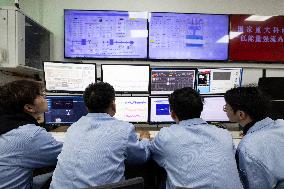
Researchers observe experiment progress at the control room of the low-energy high-intensity heavy-ion accelerator facility (LEAF) on December 10, 2024. The world's first stand-alone low-energy high-intensity heavy-ion accelerator facility (LEAF), developed by the Institute of Modern Physics of the Chinese Academy of Sciences, recently passed the expert panel acceptance inspection organized by the National Natural Science Foundation of China. The LEAF can provide intense heavy-ion beams and mixed ion beams of various charge states from light to heavy elements, offering advantages such as high beam intensity, high charge state, diverse ion species, and a wide range of energy variations. With the upgrading of ion accelerators and the evolution of accelerator technologies, frontier research in ion beam physics has continuously deepened human understanding of the world, and related application technologies have been widely adopted in various fields. Photo by Jin Liwang/Xinhua/ABACAPRESS.COM

  •  
Low-Energy High-Intensity Heavy-Ion Accelerator Facility - China

Low-Energy High-Intensity Heavy-Ion Accelerator Facility - China

Researchers analyze experimental data at the control room of the low-energy high-intensity heavy-ion accelerator facility (LEAF) on December 10, 2024. The world's first stand-alone low-energy high-intensity heavy-ion accelerator facility (LEAF), developed by the Institute of Modern Physics of the Chinese Academy of Sciences, recently passed the expert panel acceptance inspection organized by the National Natural Science Foundation of China. The LEAF can provide intense heavy-ion beams and mixed ion beams of various charge states from light to heavy elements, offering advantages such as high beam intensity, high charge state, diverse ion species, and a wide range of energy variations. With the upgrading of ion accelerators and the evolution of accelerator technologies, frontier research in ion beam physics has continuously deepened human understanding of the world, and related application technologies have been widely adopted in various fields. Photo by Jin Liwang/Xinhua/ABACAPRESS.COM

  •  
Low-Energy High-Intensity Heavy-Ion Accelerator Facility - China

Low-Energy High-Intensity Heavy-Ion Accelerator Facility - China

This stitched photo taken on December 10, 2024 shows part of the low-energy high-intensity heavy-ion accelerator facility (LEAF). The world's first stand-alone low-energy high-intensity heavy-ion accelerator facility (LEAF), developed by the Institute of Modern Physics of the Chinese Academy of Sciences, recently passed the expert panel acceptance inspection organized by the National Natural Science Foundation of China. The LEAF can provide intense heavy-ion beams and mixed ion beams of various charge states from light to heavy elements, offering advantages such as high beam intensity, high charge state, diverse ion species, and a wide range of energy variations. With the upgrading of ion accelerators and the evolution of accelerator technologies, frontier research in ion beam physics has continuously deepened human understanding of the world, and related application technologies have been widely adopted in various fields. Photo by Jin Liwang/Xinhua/ABACAPRESS.COM

  •  

Taiwan: Typhoon Kong-Rey Makes Landfall, Bringing Strong Winds, Heavy Rain 6

Typhoon Kong-rey made landfall in Taitung, southeast Taiwan, on Halloween afternoon, October 31. It brought gusty winds and heavy rainfall to eastern Taiwan and was expected to affect other regions as well.

  •  
Scientific Expedition Team At Purog Kangri Glacier - China

Scientific Expedition Team At Purog Kangri Glacier - China

An aerial drone photo taken on September 11, 2024 shows the camp of a scientific expedition team at the "Dome.C" point on the top of Purog Kangri Glacier in Shuanghu County, Nagqu, southwest China's Xizang Autonomous Region. The scientific expedition team, led by Xu Baiqing from the Institute of Tibetan Plateau Research of the Chinese Academy of Sciences (CAS), started ice core drilling at the "Dome.C" point, located at an altitude of 6,100 meters on the top of Purog Kangri Glacier, on Wednesday. Photo by Jiang Fan/Xinhua/ABACAPRESS.COM

  •  
China's Juncao technology sows seeds of hope in Africa

China's Juncao technology sows seeds of hope in Africa

Juncao expert Chen Kehua (L) and a local technician check bags of mycelium at Central African Institute of Agronomic Research in Bangui, the Central African Republic, Feb. 6, 2024. Since the 1980s, Lin Zhanxi, a professor of Fujian Agriculture and Forestry University, has led a research team on Juncao technology in China's southeastern Fujian Province. Juncao means "mushroom" and "grass" in Chinese. Its versatility is a key feature, allowing it to grow edible mushrooms, provide livestock feed and help battle desertification. Since the 1990s, China has shared the technology with over 100 countries by opening training classes and conducting on-site demonstrations. By now, Juncao technology has taken root in more than 40 African countries, helping African farmers combat poverty and promoting cooperation between China and Africa. Photo by Han Xu/Xinhua/ABACAPRESS.COM

  •  
(EyesOnSci)CHINA-SICHUAN-ABA-CAS-ZOIGE WETLAND-RESEARCH STATION-INAUGURATION (CN)

(EyesOnSci)CHINA-SICHUAN-ABA-CAS-ZOIGE WETLAND-RESEARCH STATION-INAUGURATION (CN)

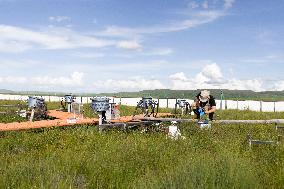
(240726) -- HONGYUAN, July 26, 2024 Photo by Xinhua/ABACAPRESS.COM) -- A researcher collects gas samples at a test platform in Zoige wetland in the Aba Tibetan and Qiang Autonomous Prefecture, southwest China's Sichuan Province, July 25, 2024. The Zoige Wetland Ecology Research Station, established by the Chengdu Institute of Biology of the Chinese Academy of Sciences in the Aba Tibetan and Qiang Autonomous Prefecture in southwest China's Sichuan Province, went operational on Friday. The station is expected to provide scientific and technical support and policy recommendations for regional ecological protection and sustainable socio-economic development in southwest China, and also make scientific explorations for global wetland protection, according to Gao Yongheng, head of the research station. The Zoige plateau, one of the main distribution areas of high-altitude wetlands in China, serves as an important ecological barrier. With the backdrop of global climate change, the region is facing significant ecolog

  •  
(EyesOnSci)CHINA-SICHUAN-ABA-CAS-ZOIGE WETLAND-RESEARCH STATION-INAUGURATION (CN)

(EyesOnSci)CHINA-SICHUAN-ABA-CAS-ZOIGE WETLAND-RESEARCH STATION-INAUGURATION (CN)

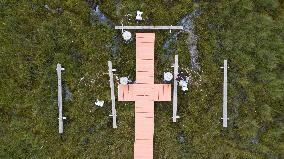
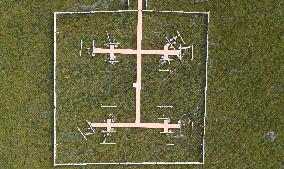
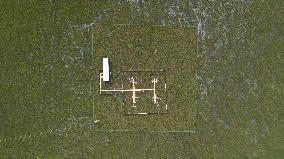
(240726) -- HONGYUAN, July 26, 2024 Photo by Xinhua/ABACAPRESS.COM) -- An aerial drone photo taken on July 25, 2024 shows a researcher collecting samples at a test platform in Zoige wetland in the Aba Tibetan and Qiang Autonomous Prefecture, southwest China's Sichuan Province. The Zoige Wetland Ecology Research Station, established by the Chengdu Institute of Biology of the Chinese Academy of Sciences in the Aba Tibetan and Qiang Autonomous Prefecture in southwest China's Sichuan Province, went operational on Friday. The station is expected to provide scientific and technical support and policy recommendations for regional ecological protection and sustainable socio-economic development in southwest China, and also make scientific explorations for global wetland protection, according to Gao Yongheng, head of the research station. The Zoige plateau, one of the main distribution areas of high-altitude wetlands in China, serves as an important ecological barrier. With the backdrop of global climate change, the r

  •  
(EyesOnSci)CHINA-SICHUAN-ABA-CAS-ZOIGE WETLAND-RESEARCH STATION-INAUGURATION (CN)

(EyesOnSci)CHINA-SICHUAN-ABA-CAS-ZOIGE WETLAND-RESEARCH STATION-INAUGURATION (CN)

(240726) -- HONGYUAN, July 26, 2024 Photo by Xinhua/ABACAPRESS.COM) -- An aerial drone photo taken on July 25, 2024 shows a researcher collecting samples at a test platform in Zoige wetland in the Aba Tibetan and Qiang Autonomous Prefecture, southwest China's Sichuan Province. The Zoige Wetland Ecology Research Station, established by the Chengdu Institute of Biology of the Chinese Academy of Sciences in the Aba Tibetan and Qiang Autonomous Prefecture in southwest China's Sichuan Province, went operational on Friday. The station is expected to provide scientific and technical support and policy recommendations for regional ecological protection and sustainable socio-economic development in southwest China, and also make scientific explorations for global wetland protection, according to Gao Yongheng, head of the research station. The Zoige plateau, one of the main distribution areas of high-altitude wetlands in China, serves as an important ecological barrier. With the backdrop of global climate change, the r

  •  
(EyesOnSci)CHINA-SICHUAN-ABA-CAS-ZOIGE WETLAND-RESEARCH STATION-INAUGURATION (CN)

(EyesOnSci)CHINA-SICHUAN-ABA-CAS-ZOIGE WETLAND-RESEARCH STATION-INAUGURATION (CN)

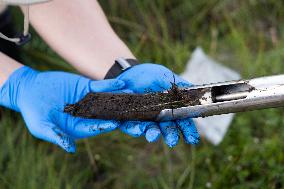
(240726) -- HONGYUAN, July 26, 2024 Photo by Xinhua/ABACAPRESS.COM) -- A researcher collects a peatland sample at a test platform in Zoige wetland in the Aba Tibetan and Qiang Autonomous Prefecture, southwest China's Sichuan Province, July 25, 2024. The Zoige Wetland Ecology Research Station, established by the Chengdu Institute of Biology of the Chinese Academy of Sciences in the Aba Tibetan and Qiang Autonomous Prefecture in southwest China's Sichuan Province, went operational on Friday. The station is expected to provide scientific and technical support and policy recommendations for regional ecological protection and sustainable socio-economic development in southwest China, and also make scientific explorations for global wetland protection, according to Gao Yongheng, head of the research station. The Zoige plateau, one of the main distribution areas of high-altitude wetlands in China, serves as an important ecological barrier. With the backdrop of global climate change, the region is facing significant

  •  
(EyesOnSci)CHINA-SICHUAN-ABA-CAS-ZOIGE WETLAND-RESEARCH STATION-INAUGURATION (CN)

(EyesOnSci)CHINA-SICHUAN-ABA-CAS-ZOIGE WETLAND-RESEARCH STATION-INAUGURATION (CN)

(240726) -- HONGYUAN, July 26, 2024 Photo by Xinhua/ABACAPRESS.COM) -- An aerial drone photo taken on July 25, 2024 shows researchers collecting samples at a test platform in Zoige wetland in the Aba Tibetan and Qiang Autonomous Prefecture, southwest China's Sichuan Province. The Zoige Wetland Ecology Research Station, established by the Chengdu Institute of Biology of the Chinese Academy of Sciences in the Aba Tibetan and Qiang Autonomous Prefecture in southwest China's Sichuan Province, went operational on Friday. The station is expected to provide scientific and technical support and policy recommendations for regional ecological protection and sustainable socio-economic development in southwest China, and also make scientific explorations for global wetland protection, according to Gao Yongheng, head of the research station. The Zoige plateau, one of the main distribution areas of high-altitude wetlands in China, serves as an important ecological barrier. With the backdrop of global climate change, the re

  • Main
  • Top
  • Editorial
  • Creative
  • About Us
  • About ILG
  • Terms of use
  • Company
  • BEHIND
  • Price List
  • Single Plan
  • Monthly Plan
  • Services
  • Shooting
  • Rights Clearance
  • Support
  • FAQ
  • How To Buy
  • Contact Us
  • Become a Partner

© KYODO NEWS IMAGES INC

All Rights Reserved.

  • Editorial
  • Olympics
  • News
  • Sports
  • Japan
  • Tech
  • Royal
  • Disaster
  • NorthKorea
  • Old Japan
  • SNS
  • Creative
  • Food
  • Japan
  • Landscape
  • Animal
  • Popular
  • #Ukraine
  • #Russia
  • #coronavirus
  • #N. Korea
  • #China
  • #Thailand
  • #Ukraine
  • #Russia
  • #coronavirus
  • #N. Korea
  • #China
  • #Thailand
  • Food
  • Japan
  • Landscape
  • Animal
  • Olympics
  • News
  • Sports
  • Japan
  • Tech
  • Royal
  • Disaster
  • NorthKorea
  • Old Japan
  • SNS